Why Is My Boat Lift Not Working? Troubleshooting Guide
Published October 1, 2026
If your boat lift suddenly stops working, the problem may be electrical, mechanical, or related to the weight or position of the boat.
Some issues are easy to spot, while others require closer inspection. A few basic troubleshooting steps can help you narrow down the problem and know when it is time to schedule professional service.
Start With the Power Supply
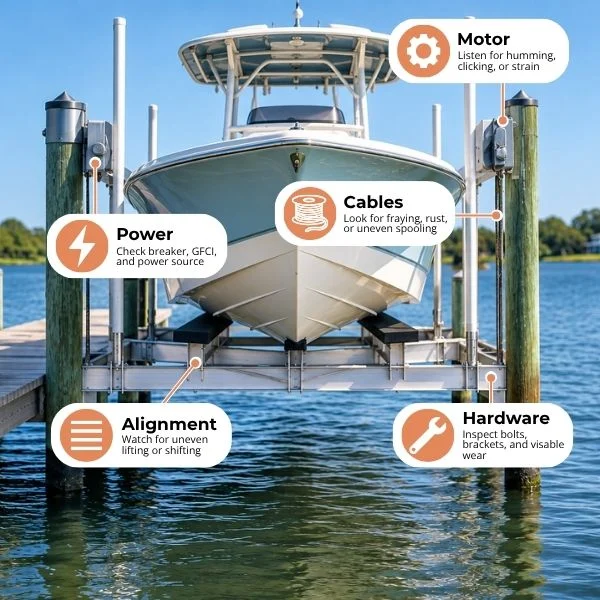
If the lift won’t raise or lower at all, start by checking whether it has power.
Look for:
F&S notes that a motor that won’t run may be caused by a loss of power, blocked contacts, or a motor that needs repair or replacement.
Does the Motor Hum or Click?
A motor that hums, clicks, or struggles without moving the boat may point to a failing capacitor, poor electrical connection, voltage drop, or an overloaded lift.
If the lift lowers normally but struggles to raise the boat, stop holding the switch down. Continuing to power a stalled motor can damage the motor windings.
Is the Lift Moving Slowly or Stalling?
Slow or strained movement may be related to:
Confirm the boat’s fully loaded weight and make sure it’s positioned evenly on the bunks. If the lift still struggles, the motor or gearbox may need to be inspected.
Is the Lift Raising Unevenly?
If one side rises or lowers faster than the other, stop using the lift until the cause is identified.
Uneven operation may be caused by cable alignment, improper tension, bunk misalignment, or other worn components. F&S notes that uneven lifting can contribute to additional cable wear and should be addressed before continued use.
Are the Cables Frayed or Not Spooling Correctly?
Cables are one of the most important components to check when a lift isn’t operating correctly. Look for fraying, rust or corrosion, broken strands, kinks, or uneven spooling around the drive shaft.
F&S recommends stopping operation if cables appear badly worn, rusty, or are not spooling cleanly.
Is the Lift Making Unusual Noises?
Grinding, popping, screeching, or other unusual noises may indicate worn bearings, loose hardware, cable problems, or motor and gearbox issues. A minor squeak may simply mean a component needs lubrication, but loud or persistent noises should be inspected before the lift is used again.